What the rooms are made of
Inside Jama Michalika: the rooms to see
A short tour of the two main rooms of Jama Michalika: the carved doorways, stained glass, caricatures and puppets that the Young Poland artists left.
Reserve your table for the show ↗Quick answer
Jama Michalika has two main rooms: an older one where the Green Balloon began, and the Frycz room, fitted out around 1910 with carved doorways, leather benches, stained glass and lamps. Look for caricatures, wall paintings, the puppets in glass cases and the stained-glass arch.
A café made by artists
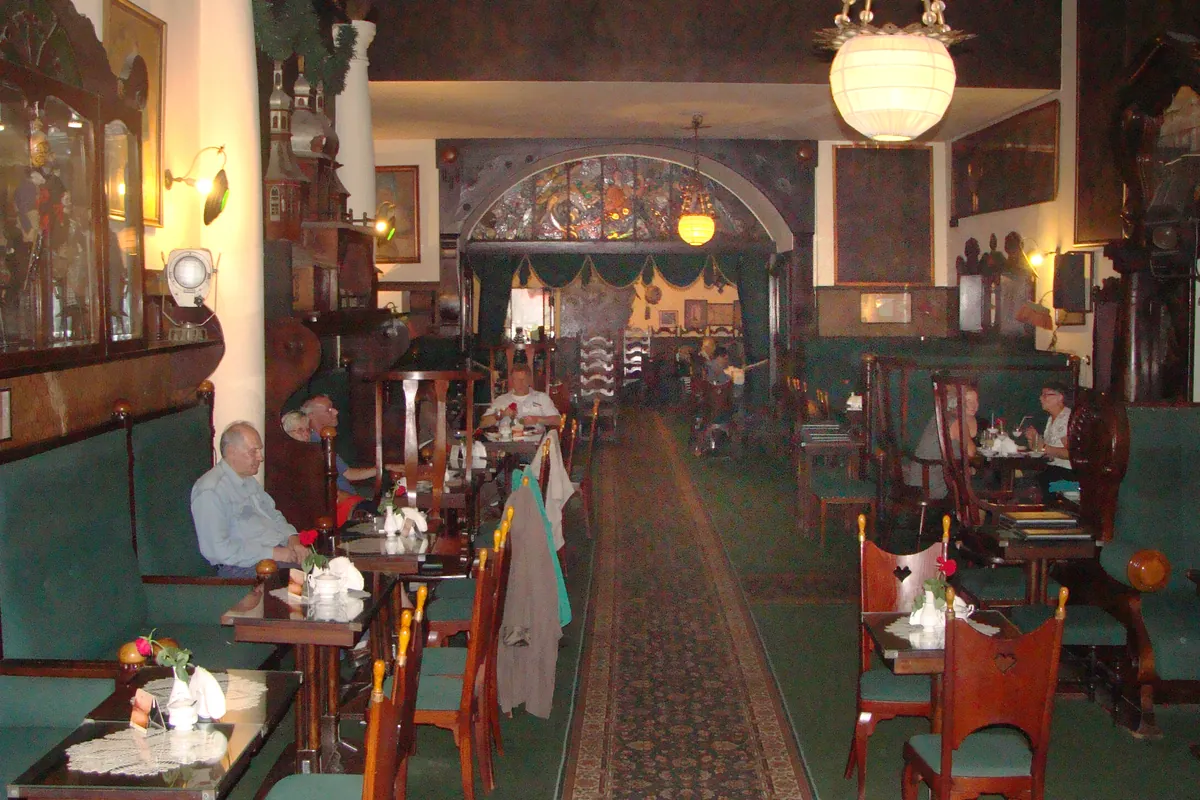
The café is tied to Young Poland, the modernist movement that ran roughly from 1890 to 1918 and centred on Kraków. Art Nouveau was its most influential visual style. In 1910 Michalik expanded the café by two rooms and a kitchen, under the architect Franciszek Mączyński. The interiors for guests were designed by the painter Karol Frycz, who made the furniture, stained-glass windows, doors and lamps, while the painter Kazimierz Sichulski designed the friezes in the larger room. Earlier, according to the Polish Wikipedia, Stanisław Wyspiański had offered to paint the whole café for the price of the paint, and Michalik declined.
How the style was described
The art historian Tadeusz Dobrowolski, quoted by Culture.pl, called the interior a blend of Art Nouveau, modern style, a church and a sort of Russian terem. In practice that means doorframes with thick, barrel-like jambs and winding lintels, heavy leather sofas with carved ornament, and small stained-glass windows. The result is dark, warm and a little odd, which is the point: it was designed as a retreat for artists, not as a showroom. The artists also drew caricatures and sketches on the spot, and these were hung on the walls of the back room, which is why the café still reads as a gallery as much as a restaurant.
The older room
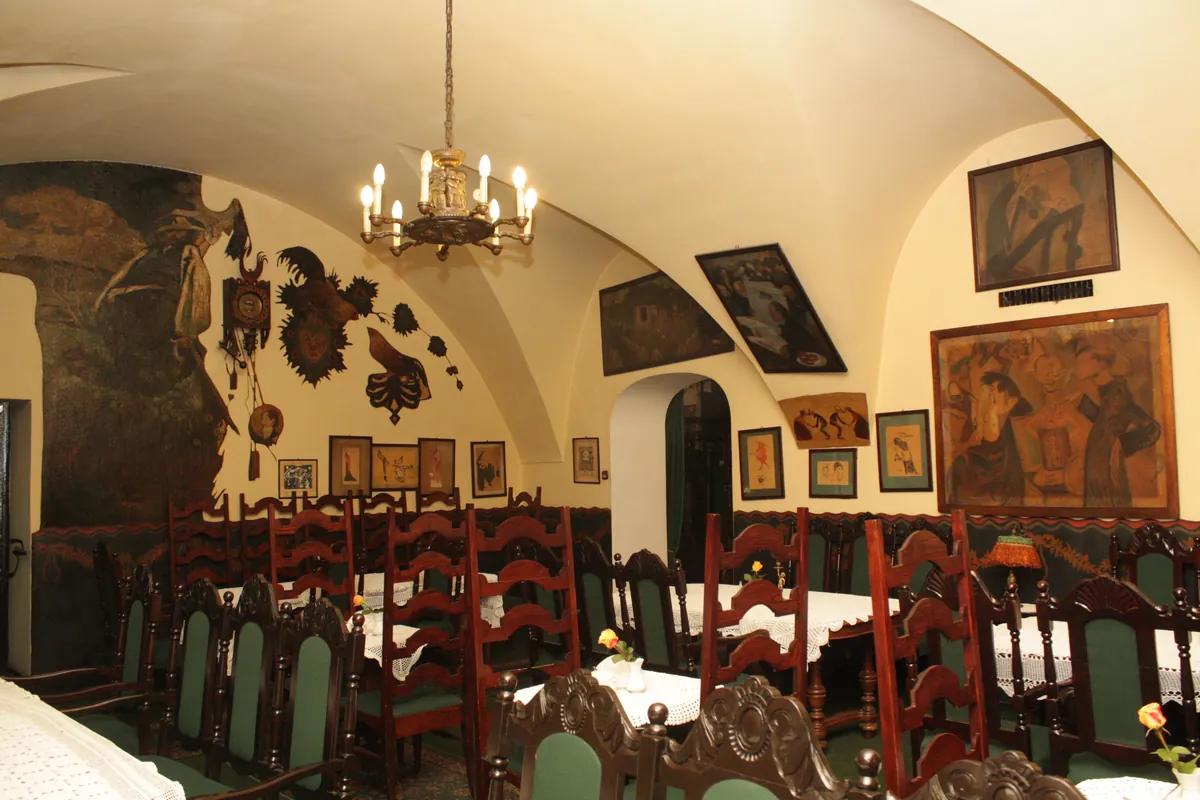
The older room was the original home of the Green Balloon. Culture.pl lists wall paintings from the golden era there, among them two fighting roosters by Tadeusz Rychter and Stanisław Czajkowski, and a caricature of the actress Irena Solska by Karol Frycz. It also holds a pendulum clock designed by Henryk Szczygliński and display cases with puppets from the cabaret. Rows of framed graphics cover the walls, so allow time to take them in one at a time, from the doorway to the far corner.
The Frycz room
The second main room is named after its designer. It has benches, chairs, mirrors and a hanging clock by Frycz, and some of the stained glass he designed, which Culture.pl says includes birds, a wildcat and Michalik himself carrying a tray of drinks and snacks. The skylight is stained glass too. On the walls hang Sichulski's 1908 painting of the Green Balloon cabaret, showing its members in a wild procession, and his comic take on the Last Judgment, populated by people from the cabaret. More puppets and a miniature stage stand here as well.
The raised corner
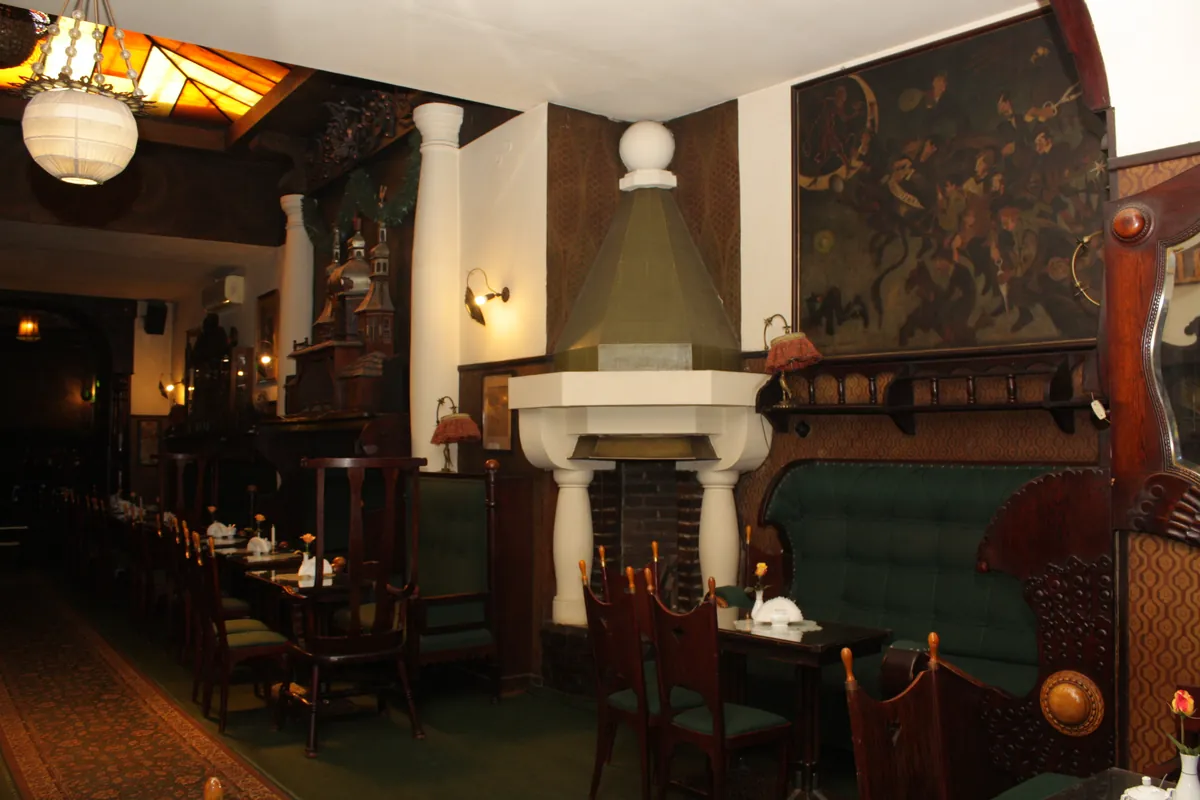
A small, slightly raised chamber opens off the Frycz room, known as the top, and serves as a stage. It carries lithographs and caricatures, including portraits of people from the cabaret's circle. Together the rooms are why a folk show feels at home here: the performers play in a space that was built for performance, with glass, wood and a raised corner that already looks like a stage. The photograph shows a white hooded fireplace beside a green leather bench, under a large painting.
A note on what changes
Rooms get rearranged, tables move and the restoration history is long: according to the Polish Wikipedia, the painted decorations were rescued and restored in 1992, and an earlier restoration in 1956 drew objections from Frycz himself. Treat this guide as a map of what to look for, not a promise of a specific object on a specific wall. If a particular painting or window matters to you, ask the staff when you arrive; they know the room better than any page does, and they have probably been asked before.
Frequently asked questions
Who designed the interior?
Karol Frycz designed the furniture, stained glass, doors and lamps around 1910, with Kazimierz Sichulski designing friezes, according to Culture.pl. The works were overseen by the architect Franciszek Mączyński.
What is Young Poland?
A modernist movement in Polish art, literature and music that ran roughly from 1890 to 1918 and centred on Kraków, according to Wikipedia. Art Nouveau was its most influential visual style.
Which room will I sit in?
That depends on the evening. Your confirmation and the staff will tell you where you sit, and both main rooms are worth a look if you can see them.
Sources